One entity. Many names. Every name needs to find the others.
Characters get called more than one thing. The full name in the opening. The first name in conversation. The nickname between intimates. The formal title in court. The diminutive in the diary. By the time a manuscript runs the length of a novel, a single character has typically been named six, eight, ten different ways — sometimes more.
And it isn't only characters. Places get called several things (the city's name, "the city," "back home"). Objects get reframed. Concepts get paraphrased. Every recurring entity in a manuscript has surface forms.
Searching for one form doesn't find the others. Find-and-replace breaks dialogue and risks matching the wrong text. The continuity question — have I been calling this consistently? and if I haven't, where exactly are the variants? — gets harder with every chapter.
How aliases work.
Every entity in your project has one canonical form — the full name, the formal version, whatever you decide to treat as the master record. Every other surface form gets linked to it as an alias.
"Bob" is an alias of "Robert Calloway." "Mississippi River," "the Mississippi," and "the river" are all aliases of one canonical river entity. "The Count" is an alias of "Dracula." Once the link is made, the variants all roll up to the canonical record.
What that buys you:
- Search expansion. Search for any variant and every paragraph where any form appears is in the results.
- Manuscript-wide tagging. Every paragraph that mentions any form is tagged as that canonical entity — in the Plot Line Map, in Insight, in the Character Presence Map, everywhere.
- One source of truth. The canonical's profile, relationships, and cross-references apply to every variant. No duplicate records to maintain.
AI proposes aliases during a scan; you confirm them. Or you can add them manually at any time. Conversions both ways — alias to canonical, alias to relationship — are a single click when you discover the categorization was wrong.
Nine names for one river.
We ran the memoir core of Mark Twain's Life on the Mississippi through NovelContinuity. The river runs through every chapter under nine different names.

The Mississippi River canonical with nine alias chips linked underneath.
Mississippi. The Mississippi. The Mississippi River. Lower Mississippi. Upper Mississippi. Upper Mississippi River. The river. River. The upper river. Nine ways Twain named the river that runs through every chapter — the formal name, the bare name, the article-prefixed forms, the regional sub-names, the generic references when the river was so present it didn't need naming.
Nine variants of one character.
Regency naming convention is harder than gothic naming. The same scan, run on Jane Austen's Pride and Prejudice, resolved nine surface forms of the protagonist alone.
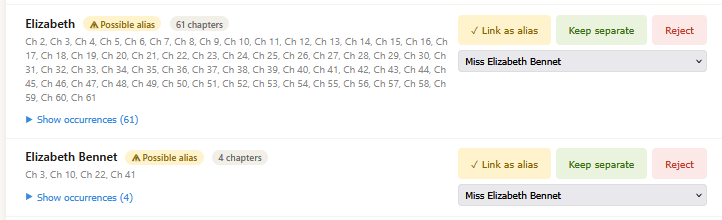
Two of the nine: "Elizabeth" used in all 61 chapters, and the formal "Elizabeth Bennet" in four. Both flagged as possible aliases of the canonical Miss Elizabeth Bennet.
Elizabeth. Lizzy. Eliza. Miss Elizabeth. Elizabeth Bennet. Miss Eliza. Eliza Bennet. Lizzie. Mrs. Darcy. Nine surface forms of one character. Plus the same shape of disambiguation for almost every other named character in the book. "Miss Bennet" alone refers to whichever of the five sisters is currently the eldest unmarried one, and the canonical referent shifts as the book progresses.
The scan proposed every link. A novelist with the review screen open accepted or rejected each one — including nine proposals the scan got wrong, the most memorable being a suggestion that Mr. Darcy was an alias of his own deceased father. Caught in a click. The AI proposes; the writer decides.
33 mentions, four clicks.
And from Bram Stoker's Dracula — four ways one character gets named across a 27-chapter gothic.
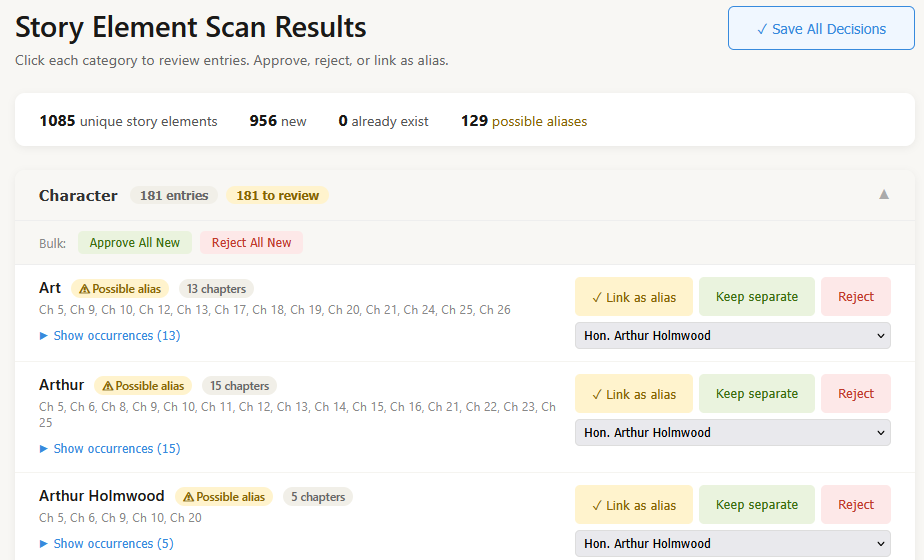
Possible character aliases surfaced by the Dracula scan — Art, Arthur, Arthur Holmwood, and Hon. Arthur Holmwood — with link-as-alias controls beside each.
Art. Arthur. Arthur Holmwood. Hon. Arthur Holmwood. Same person, different names depending on who's talking and what context. The chapter scan picked up 13 occurrences of "Art" as a possible alias of Hon. Arthur Holmwood, 15 of "Arthur," and 5 of "Arthur Holmwood." Without a tool, that's an afternoon of find-and-replace and a real risk of breaking dialogue or matching the wrong text. With NovelContinuity, it's four clicks. Once confirmed, every occurrence across the manuscript is tagged as the same person.
Beyond names.
Aliases work for any entity that gets called more than one thing. In the Twain scan, the same workflow handled:
- A character chain. "Mr. Bixby, Bixby, my chief, my gunpowdery chief" — four forms of one pilot across eight chapters.
- A cluster. "Edward, Eddy, Edmund, Edwin" — five forms in one paragraph, where the variation is the joke.
- A phonetic dialect form. "Sent Louis" — how a raftsman pronounces St. Louis in Chapter 3 — rolled up to the formal city name.
- A thematic paraphrase. "Servitude vs. freedom" and "emancipation and freedom" both rolled up to the canonical theme "slavery and freedom." Same workflow, applied to concepts rather than names.
Six kinds of variation. One alias system. Whatever your manuscript treats as the same entity under different surface forms, aliases collapse the variants into one searchable, taggable, findable record.
Aliases connect to the rest of the system.
Aliases are one of three ways NovelContinuity links entities. Aliases link different names for the same entity. Cross-references (XReferences) link entities of different types — a character to a location, an event to a business. Relationships describe how two separate entities connect — husband/wife, employer/employee, rivals. All three operate on canonical entities, so a confirmed alias counts everywhere: in search, in Plot Line tagging, on the Character Presence Map, in Insight.