20 chapters. One reading. A young pilot's apprenticeship, his brother's death, the end of an era — all visible at a glance. Real screenshots, real text, no mockups.
Twain wrote 60 chapters; the first two are historical preface, and the last 38 are his return trip. We ran the 20 that contain the actual memoir — chapters 3 through 22, the boyhood, the apprenticeship, and the catastrophe that ended it.
This is the actual review screen for the central tragedy of the memoir, reading Twain's text. Nothing staged.
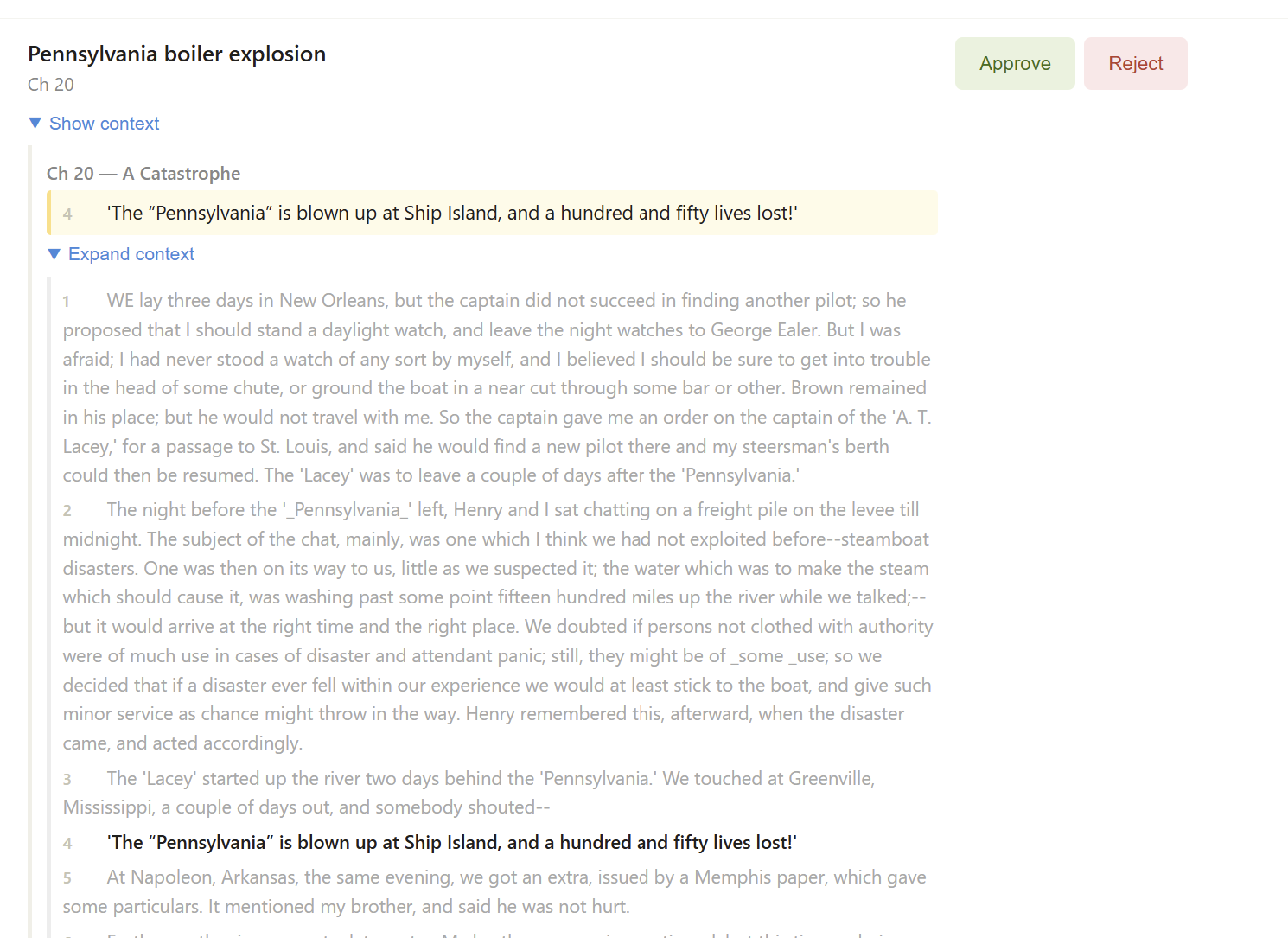
The engine extracted Twain's central tragedy from the moment the news arrives. Chapter 20 — Twain's own title for it is A Catastrophe — and the highlighted anchor row is the announcement that broke the news to the rest of the boat. Twain's brother Henry was on the Pennsylvania when it exploded. The book was written twenty-one years later.
Every detected element works this way. Each one anchored to a paragraph. Each paragraph one click away from its surrounding context. A writer reviewing a 600-element scan isn't reading a list of names — they're seeing exactly where in the manuscript each one came from, ready to confirm, reject, or link with full evidence in front of them.
— The exact sentence the engine attached to the event, from Twain's Chapter 20.
One lens, not a verdict. There is no "correct" emphasis — this is observation, not a judgment of importance.
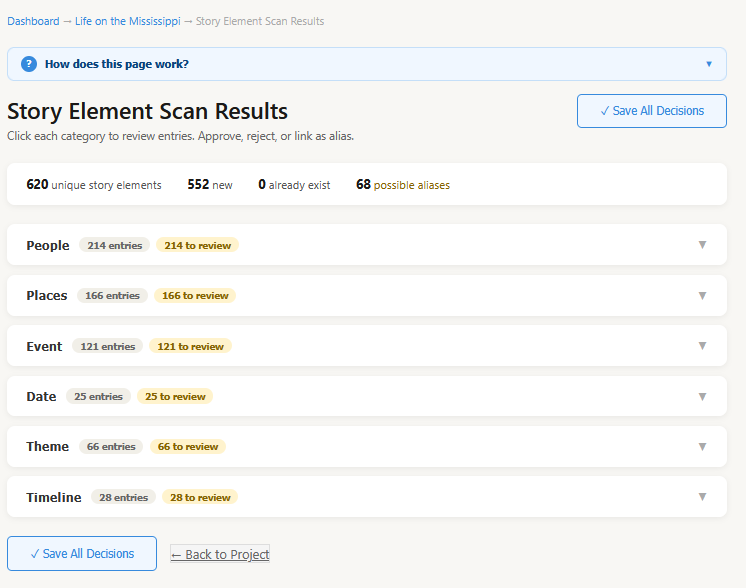
NovelContinuity didn't just count names and places. It noticed what kind of book it was reading.
Look at the categories themselves. Theme. That isn't a field that appears in a mystery novel or a domestic romance. The Dracula scan surfaced Evidence, Suspects, and Alibis because it was reading a criminal investigation dressed as a gothic novel. The Pride and Prejudice scan surfaced Meetings, Businesses, and Reviews because Austen's book is fundamentally about people calling on each other. This scan surfaces themes, because that's what a memoir is built around.
66 distinct themes. The science of piloting. The decline of steamboating. The loss of beauty through expertise. Slavery and freedom. Those are concepts a memoir tracks — the questions the past raises — and no other genre template surfaces them. The display labels too: People instead of Character, Places instead of Location. The categories writers in this genre would actually use, not the engine's internal names.
The Mississippi River runs through every chapter of the memoir under nine different names. NovelContinuity flagged each variant, the writer confirmed each link, every mention now rolls up to one canonical.
Mississippi. the Mississippi. the Mississippi River. Lower Mississippi. Upper Mississippi. Upper Mississippi River. the river. river. the upper river. Nine ways Twain named the river that runs through every chapter — the formal name, the bare name, the article-prefixed forms, the regional sub-names, the generic references when the river was so present it didn't need naming. The scan proposed every link. The writer confirmed each one in a tap. Once confirmed, search any form and all of them surface together, anchored to the same canonical entry.
The same workflow handled Twain's other naming variants. The Mr. Bixby chain — Mr. Bixby, Bixby, my chief, my gunpowdery chief — four forms of one pilot across eight chapters. The Ed cluster — Edward, Eddy, Edmund, Edwin — five forms in one paragraph, where the variation is the joke. The phonetic dialect form — "Sent Louis," how a raftsman pronounces St. Louis in Chapter 3 — rolled up to the formal city name. The thematic paraphrase — "servitude vs. freedom" and "emancipation and freedom" both rolled up to "slavery and freedom" — same workflow, applied to concepts rather than names. Six kinds of variation. One alias system.
Every novelist has had that thought. NovelContinuity is the answer.
Imagine what it'll see in your draft.
Apply for Beta Access
