61 chapters. One reading. Five interwoven courtships, visible at a glance. Real screenshots, real text, no mockups.
This is the actual Plot Line Map screen, reading Jane Austen's text. Nothing staged.
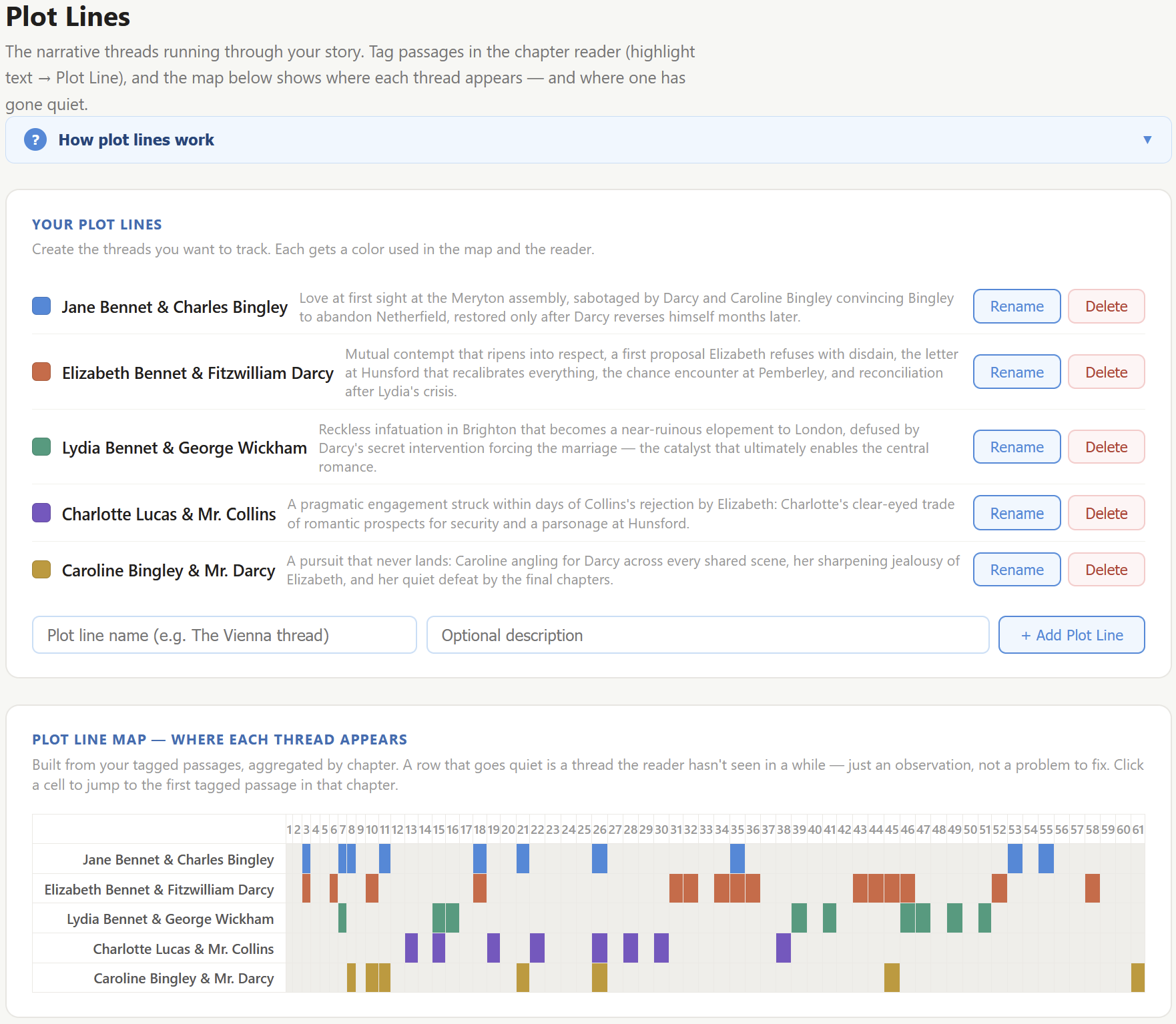
Elizabeth and Darcy are present throughout the book, but the thread clusters and breaks — tight at the start, dormant in the middle, then a cluster of five beats around the proposal-and-letter at Hunsford, another silence, then six beats clustered through Pemberley and the reconciliation. Jane and Bingley go quiet for nearly thirty chapters in the middle. Lydia and Wickham don't really exist as a thread until the Brighton invitation, then explode into the final third. Charlotte and Collins is a contained subplot bounded entirely between chapters 13 and 38. Caroline and Darcy never really lands.
A row that goes quiet is a thread the reader hasn't seen in a while — just an observation, not a problem to fix. The map shows where the threads converge, too. Chapter 35 fires on two rows at once, because Darcy's letter is a single document that moves both Jane & Bingley and Elizabeth & Darcy simultaneously. Chapter 46 fires on two rows because the elopement letter arrives the moment Darcy walks in. Chapter 52 resolves Lydia & Wickham and Elizabeth & Darcy together.
— The same observation a working novelist would make about her own draft, surfaced from the text in a single reading.
One lens, not a verdict. There is no "correct" shape — this is observation, not a judgment of quality.
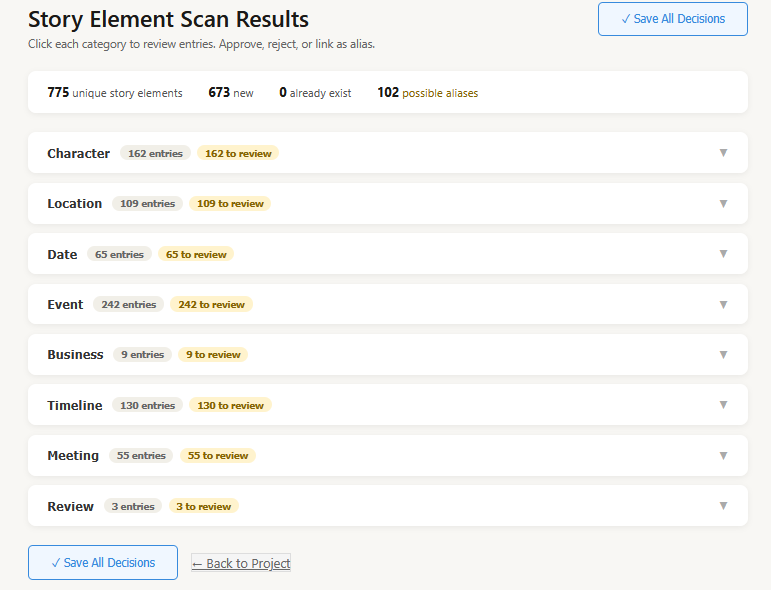
NovelContinuity didn't just count names and places. It noticed what kind of book it was reading.
Look at the categories themselves. Meetings. Businesses. Reviews. The Dracula scan surfaced Evidence, Suspects, and Alibis because it was reading a criminal investigation dressed as a gothic novel. The Pride and Prejudice scan surfaces nothing of the sort — there's no crime to track. Instead it surfaces 55 distinct meetings, because the book is fundamentally about people calling on each other; nine businesses, because the militia, Mr. Gardiner's trade, and Mr. Phillips's law practice all sit at the structural edges of the world.
Same engine, completely different lens. The categories that mattered for Dracula didn't appear here. Different ones did.
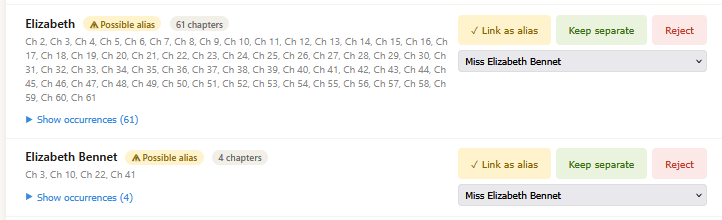
Two of the nine are visible below — "Elizabeth" itself, used in all 61 chapters, and "Elizabeth Bennet," the formal form, used in four. Both flagged by the scan as possible aliases of the canonical Miss Elizabeth Bennet. Both confirmed in a tap.
Regency naming convention is harder than gothic naming. The Dracula scan resolved four variants of Arthur Holmwood. The Pride and Prejudice scan resolved nine variants of the protagonist alone — Elizabeth, Lizzy, Eliza, Miss Elizabeth, Elizabeth Bennet, Miss Eliza, Eliza Bennet, Lizzie, Mrs. Darcy — plus the same shape of disambiguation for almost every other named character. "Miss Bennet" alone refers to whichever of the five sisters is currently the eldest unmarried one, and the canonical referent shifts as the book progresses.
The scan proposed every link. A novelist with the review screen open accepted or rejected each one — including nine proposals the scan got wrong, the most memorable being a suggestion that Mr. Darcy was an alias of his own deceased father. Caught in a click. NovelContinuity is never the final word on your characters.
Every novelist has had that thought. NovelContinuity is the answer.
Imagine what it'll see in your draft.
Apply for Beta Access