Which thread is this chapter actually carrying?
Every novel has more than one thread. The protagonist's arc. The romance. The investigation. The subplot that wraps in act two. The thematic line that runs underneath everything else. You know they're there. The question is harder than it sounds: which thread is each scene actually moving?
Character presence answers who is here. A character can be present in a chapter without the chapter moving any of their threads forward — a backstory scene, a check-in, a moment of texture. Plot Lines answer the other question: what is moving.
Two writers reading the same manuscript will give the same answers about who appears where. They'll give very different answers about which threads are actually advancing. The first question is observation. The second is craft.
How it works.
Plot Lines work in two phases.
Phase one — you bring the threads.
On the Plot Lines page, you create the threads your book is following. Each one gets a short name (Investigation, The Romance, Maya's Arc, The Cover-Up) and a color. There's no template to fight against; you name what you actually think is there.
Phase two — you tag where each one moves.
In the chapter reader, paragraphs you read while looking for each thread get tagged. Not every mention — the paragraph where the thread turns. The discovery, the decision, the moment something shifts. The tagged paragraph shows a small colored dot inline; the chapter's Plot Lines panel lists every tag.
This is a different kind of reading than writing. Phase one is intention. Phase two tests intention against what's on the page.
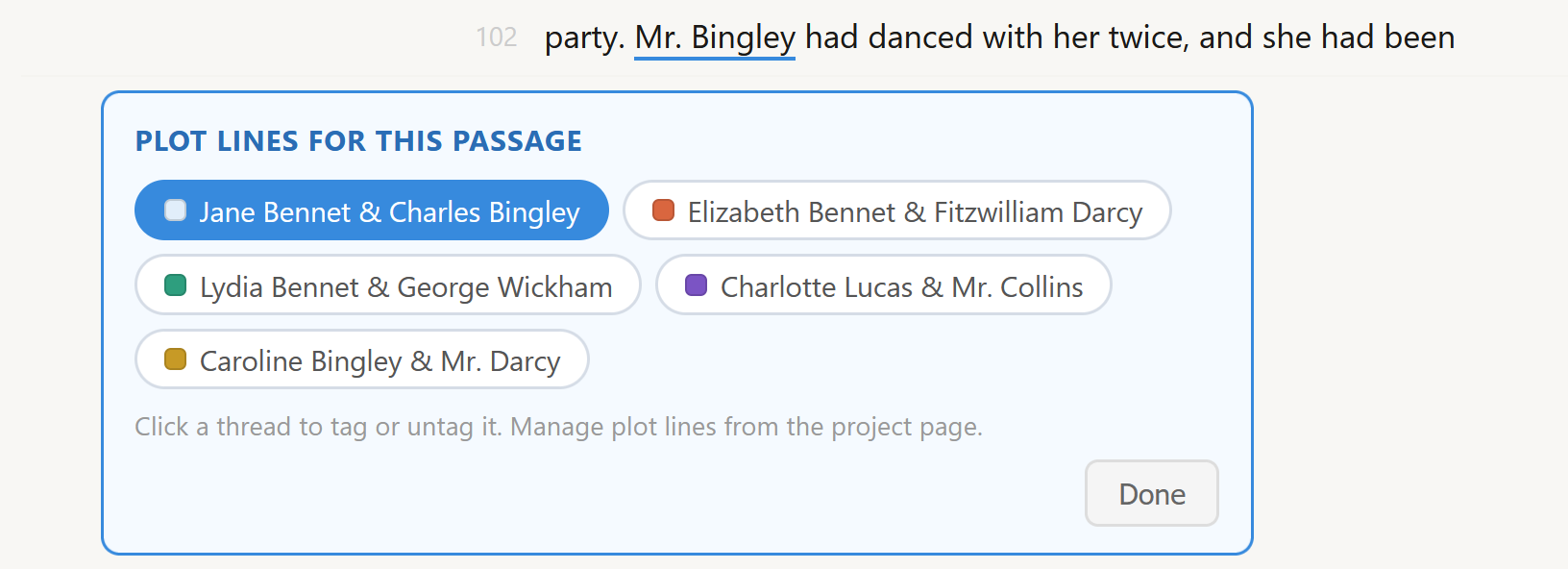
The Plot Lines tag picker, open below a paragraph in Pride and Prejudice. One click tags this beat with the Jane & Bingley thread.
The Plot Line Map.
Tag enough paragraphs and a map emerges: threads down the left, chapters across the top, colored dots where each thread fires. A row that's full means the thread is alive; a row with a long stretch of empty cells means the thread has gone quiet.
Some threads should go quiet. A subplot that resolves in chapter 18 isn't a problem when chapter 19 doesn't carry it. Other threads going quiet for ten chapters is exactly the kind of thing a writer wants to know about — not to fix automatically, but to look at.
The map shows where threads converge, too. A chapter that fires on two rows at once is doing structural work: one document moving two threads, one scene resolving two arcs. That convergence isn't visible in a prose summary. The map shows it at a glance.
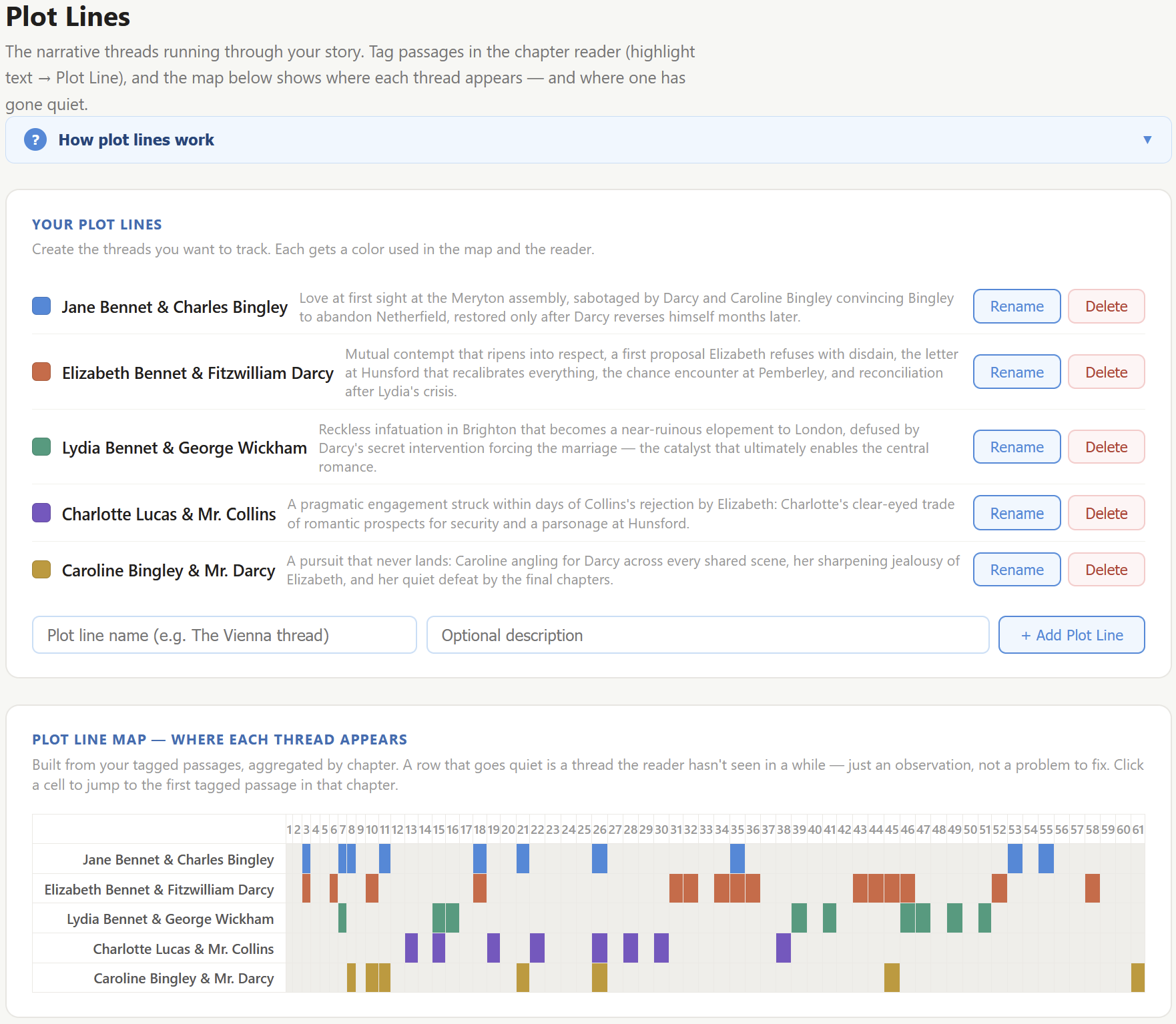
The Plot Line Map from a full scan of Pride and Prejudice — five threads, 61 chapters, every beat shown.
Tag beats, not mentions.
A character who walks into a room isn't a beat. A character making a decision that changes what the thread does next is. The simple test:
If I read only the tagged paragraphs in order, would they tell the story of the thread? Or would they just describe a character?
If the answer is "tell the story" — tag it. If the answer is "describe a character" — don't. Characterization is character presence's job. Plot Lines track movement.
This is the judgment call the feature is built around. The repeated decision — is this a beat or a mention? — is itself the craft. The map is the picture of those judgment calls, aggregated across an entire draft.
Worked example: Pride and Prejudice.
We ran the full text of Jane Austen's novel through NovelContinuity and tagged six plot threads across all 61 chapters: Jane and Bingley, Elizabeth and Darcy, Lydia and Wickham, Charlotte and Collins, Caroline and Darcy, and the family's economic situation.
The map showed what prose summary can't. Elizabeth and Darcy is dormant through the middle of the book, then clusters around the proposal at Hunsford, falls silent again, then clusters again around Pemberley. Jane and Bingley goes quiet for nearly thirty chapters. Lydia and Wickham doesn't exist as a thread until the Brighton invitation, then explodes into the final third. Charlotte and Collins is a contained subplot bounded entirely between chapters 13 and 38.
And one thread doesn't really land. Caroline and Darcy — the courtship Austen sets up but doesn't develop — shows as a near-empty row. That's not a flaw in the novel; it's an observation about how Austen actually uses that thread (as a foil, not a beat). Seeing it on the map is faster than re-reading 61 chapters to find out.
Observation, not verdict.
The Plot Line Map doesn't tell you a thread is "underdeveloped" or that a stretch of silence is too long. It shows you what's there. The interpretation is yours.
A long quiet stretch might be exactly what your story needs — deliberate restraint, slow burn, the thread held in reserve. Or it might be a thread you forgot about. The tool doesn't know which it is. You do.
Plot Lines work with the rest of the system.
Plot Lines are one of two complementary maps in NovelContinuity. The Timeline answers when something happens; Plot Lines answer which thread it carries forward. Same draft, different lenses. Together they show the architecture of a complex book, not just its contents.
The Character Presence Map in Insight shows who appears in each chapter — the complement to Plot Lines' "what is moving" view. The Before You Write compass surfaces threads that have gone quiet so you can pick them up in the next chapter if you choose to.