What does each chapter feel like to a fresh reader?
You wrote your manuscript a chapter at a time. You know each one intimately. You know what you intended every scene to do, where every beat was supposed to land, why every chapter follows the one before.
A first-time reader knows none of that. They only know what they're feeling as they read — the rhythm of setup and payoff, the chapters of slow building, the chapters where something cracks open. They experience an emotional architecture you can't quite see anymore because you built it.
Emotional Beat Classification is that reader's-eye view. AI reads each chapter, identifies its dominant emotional beat, and explains why. It's a single outside reading — one that hasn't been shaped by your knowledge of where the story is going.
How it works.
AI reads each chapter of your manuscript and labels it with its dominant emotional beat — setup, revelation, confrontation, crisis, resolution, and several others. Each chapter becomes a single colored chip. Twenty-seven chapters becomes a row of twenty-seven chips.
The chips form a horizontal view of the entire manuscript. You see at a glance where setup chapters cluster, where revelations land, where crisis takes over, where the architecture changes shape. Three or more chapters in a row sharing the same beat get a highlight ring — a streak indicator that surfaces the places a working novelist would look first when thinking about pacing.
Click any chip and a tooltip opens with the chapter's beat label, a Why? explanation drawn from the chapter's actual events, and the AI's reasoning. Every label is explained. Nothing is asserted without evidence.
Worked example: Dracula.
We ran the full text of Bram Stoker's novel through NovelContinuity. 27 chapters. The architecture of a gothic thriller, surfaced from the text in a single reading.
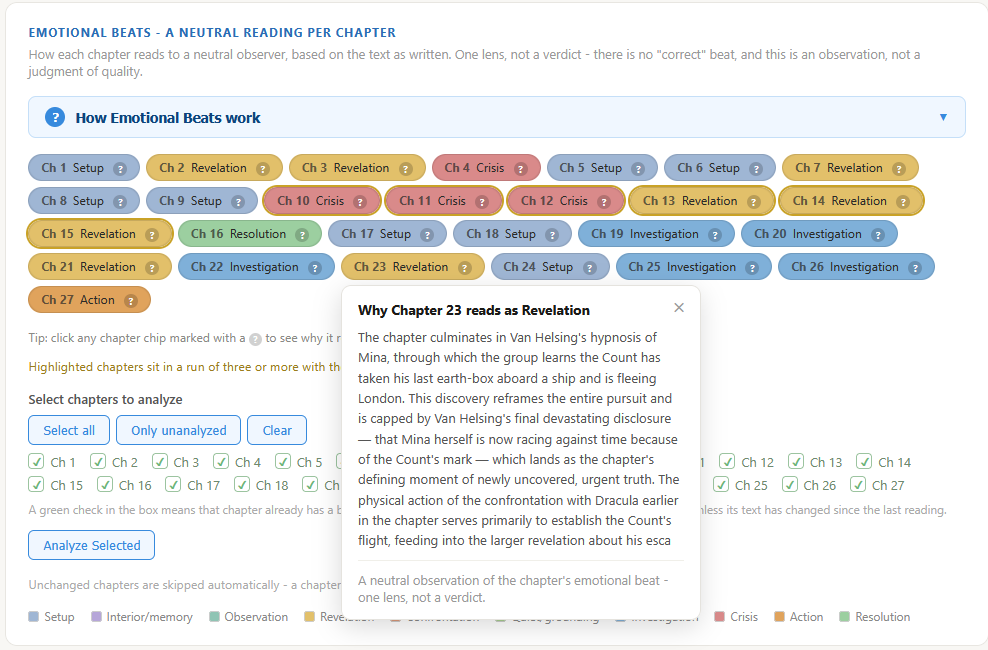
27 chapters of Dracula, every chapter labeled with its dominant emotional beat. The Chapter 23 tooltip shows the Why? explanation.
Setup and Revelation dominate the early chapters. Crisis clusters in the middle. Investigation emerges late. Action lands at Chapter 27. That's the architecture of a gothic thriller, surfaced from the text in a single reading.
The highlighted chips mark runs of three or more chapters in the same beat — the places a working novelist would look first when diagnosing pacing. The Chapter 23 tooltip opens to show the Why? for that chapter's label:
— NovelContinuity's full reasoning for Chapter 23.
That same reasoning sits behind every chapter chip. The labels aren't arbitrary; they're earned by evidence in the prose. You can disagree with one — an outside reading isn't always the one you'd give yourself. That disagreement is information too.
The beats.
NovelContinuity classifies each chapter into one of a defined set of emotional beats. They aren't genre-specific — they're shapes a chapter can take regardless of whether it's literary fiction, thriller, memoir, or mystery.
The beats are deliberately broad. Two chapters labeled "Crisis" might feel very different on the page; what they share is structural pressure peaking, not specific content. The point isn't to put every chapter in a box. The point is to see the shape your manuscript actually moves through.
Non-editable by design.
Emotional Beat labels can't be edited. That's deliberate.
The whole value of an outside reading is that it hasn't been shaped by your knowledge of the story. If you could overwrite the labels with the ones you wanted them to be, you'd just be looking at your own intentions reflected back — useful, but not what this feature is for. The AI's reading is fixed because the moment you can change it, it stops being an outside reading.
You can disagree with a label. You can decide a chapter's "Setup" should have felt like a "Revelation." That disagreement is information — it tells you about the gap between what you intended and what landed. The label staying in place is what makes the gap visible.
Observation, not verdict.
Emotional Beats don't tell you a chapter is "too slow" or that a streak of Crisis is too long. They show you what's there. The interpretation is yours.
A streak of three Setup chapters might be exactly what your story needs — deliberate world-building, slow burn, restraint before everything cracks open. Or it might mean you're stalling. The tool doesn't know. You do.
Emotional Beats are part of Insight.
Emotional Beats is one piece of the Insight dashboard — the analytical layer of NovelContinuity. Other Insight features show pacing per chapter, dialogue-vs-prose trends, the Character Presence Map, and the Before You Write compass that surfaces what to keep in mind for your next chapter.
Together, they reflect your manuscript's shape back to you across multiple lenses. The beats show its emotional architecture. The pacing shows its rhythm. The Presence Map shows its cast distribution. None of them tells you what to do — that judgment stays with you.